WRITING
Blog.
Insights on AI agents, voice AI, and autonomous workflows from the AI Hero team.
Building AI-native software needs a new paradigm
By AI Hero Team
AI-native software isn't a thing you buy off the shelf or a thing you commission and walk away from. Agents make the build cheap, but the software has to keep changing — usage teaches you what the design got wrong, priorities shift, scope grows, and your own people get better at the tools. That needs a different paradigm than SaaS, consulting, or forward-deployed engineering: a product team that stays, priced like SaaS.
Hiro: an ops triage console that acts on its own
By AI Hero Team
Every AI tool today is chat-first: the agent waits for you to open a window and ask. Hiro is a design-sprint prototype that turns the channel around: the agent does the overnight triage, acts inside the bounds you set, and reaches out to you when a decision needs its owner. Human-in-the-loop before the agent commits, and a human at the helm rather than planted in the middle of the work.
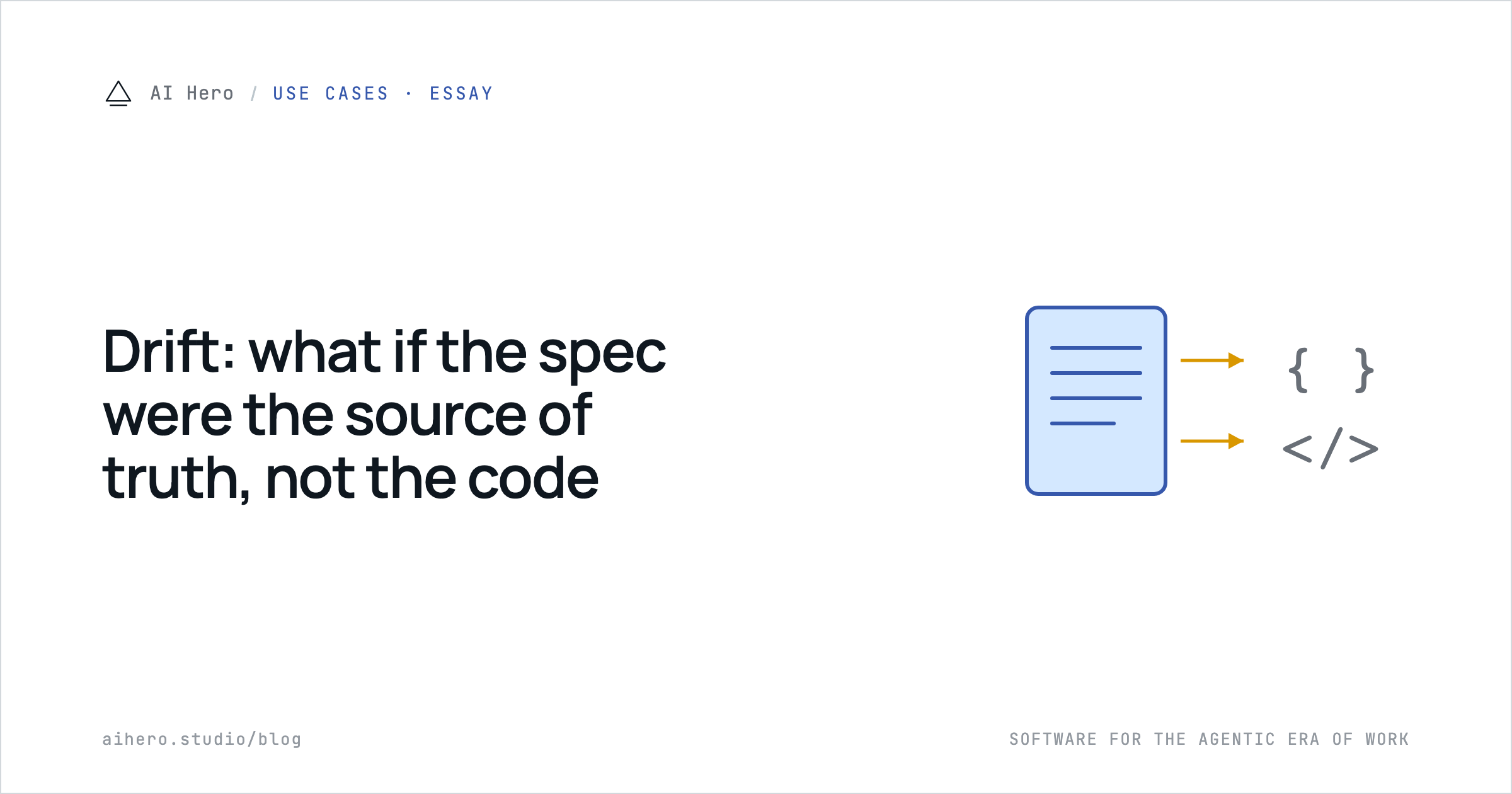
Drift: what if the spec were the source of truth, not the code
By AI Hero Team
Coding agents can write and review the code, but systems built one shot at a time degrade on decisions nobody can explain. Drift is a sprint concept for the missing layer: the product team defines the target software, main is the actual state, and in between sits an ordered graph of discussions and work that agents execute branch by branch. Neither waterfall nor sprints: a flow model.
Saga: a control room for a workforce of agents
By AI Hero Team
Three reasons to capture how your agents do the work, not just whether it got done. The EU AI Act's record-keeping obligations for high-risk systems apply from August 2, 2026. The trajectory is the only honest explanation of agent behavior. And improvement is hill-climbing: the agent explores, a skill captures the route, and tracked steps tell you what to refine. Saga is a design prototype for the console that serves all three.
Fidé: keeping compliance live instead of quarterly
By AI Hero Team
When a customer asks if you're compliant, they usually mean a standard: SOC 2, ISO 27001. But most of what an organization actually enforces is its own policy, from pre-commit hooks to what the cafeteria kitchen stocks, and those rules live in wikis, spreadsheets, and people's heads. Fidé is a concept from one of our sprints: a platform for exactly that — define controls, group them into checklists, apply them to targets, and let agents keep every check current.
Data Rooms: turning a pile of records into something you can ask
By AI Hero Team
You're across from a cardiologist who asks when your LDL started climbing. The answer is in six lab reports you own and can't use, because a folder is inert. Data Rooms is a design prototype where software reads the pile into structured data and a timeline, then does the next piece of work: drafting the appeal, answering the diligence question, and flagging the document that's missing. The same shape fits fundraising, buying a house, and customer onboarding.
Author: send a paragraph, get a finished draft
By AI Hero Team
AI drafts read like AI, and a draft you can't send is worth nothing. Author is a design-sprint prototype built on a different split of the work: you supply the beats (an outline, a TL;DR, the points you want to hit), a style guide mined from your previous writing carries the voice, and the agent does the shaping. We're building it to write AI Hero's own posts and social content, and to customize it for customers whose marketing should sound like them.
Flow: making a company's real process the interface
By AI Hero Team
The process that actually runs a company lives in someone's head and a dozen stale docs. Writing it into a document captures it for auditors; nobody works in a doc. Flow is a design prototype about capturing the process into software instead — swimlanes the team recognizes as true, a manual-assisted-automated dial on every step, and the exceptions out in the open.
Autonomous Humans: running an events program end to end
By AI Hero Team
Autonomous Humans is an initiative to help non-technical people learn to use AI in their work, through courses, cohorts, and a rolling program of online events. Plenty of platforms host one event well; none of them treats the cohorts and the events together as one thing you can operate. So we prototyped that software: every session on one screen, walking the same planned-to-live route, with agents doing the paperwork between an operator's decisions.
North: making strategy something you can operate
By AI Hero Team
Quarterly OKR reviews were built for work done at human speed. Once agents do part of the work continuously, leaders need two new things: direction people can follow week by week, and a check that agent output still serves the plan. North is a design-sprint prototype of that surface — every piece of work, human or agent, rolling up through function KPIs into the company's objectives, with agents keeping the messy inputs reconciled and people keeping every decision.
Cozy: a relationship manager that keeps the context close
By AI Hero Team
As more of what reaches us is written by software, the human part of a relationship is the part worth protecting. Cozy is a sprint exploration of a personal relationship manager that offloads the remembering: speak a note and it files itself, reminders arrive carrying reasons, and every surface says who can see it. The design decisions are the point.
Lemur: a course platform where the tutor only knows the lesson
By AI Hero Team
AI transformation stalls at people. One company we talked to refused generic training content outright and asked for every lesson to be rebuilt around its own processes. Lemur is the prototype that request calls for: an AI-native LMS with courses, paths, and cohort progress on a published curriculum, and a tutor on every lesson page that answers only from the material and can switch from explaining to checking.
The design system behind software that ships on day one
By AI Hero Team
Coding agents write most of our UI now, and an agent without a design system gives you a different product every time you ask. So we built the system before we designed a single app: one ink ramp, one indigo accent, a fixed status vocabulary, and a composer on every surface, served where the agents can pull from it. It's why every prototype in our gallery looks like one studio made it.
Auth: one login for every app you're entitled to
By AI Hero Team
Agents act on your behalf now, and they need bounded, auditable access just like employees do. Auth is a design prototype for that access surface: a portal that shows exactly what you can open, entitlement recomputed from your teams at every load so a stale grant can't exist, and an agency — a defined set of actions an agent holds on specific projects.
Primer: a library for your team's agent skills
By AI Hero Team
Skills have become the standard way to teach agents how work gets done: a SKILL.md of plain-language instructions, packaged with references, code, and artifacts. Today they live in git repos and only engineers touch them. As skills spread to the rest of the organization, teams need one place to define, update, share, and watch them. Primer is a design prototype of that place.
Why Agents Need Skills: Doing the Job the Way You Want, Unsupervised
By AI Hero Team
LLMs come with tool use, but they don't come with your order of operations. For a one-off task the agentic loop can figure out a plan; on repeated work, rediscovering the plan by trial and error produces inconsistent outcomes. We measured what it takes for an agent to follow a Standard Operating Procedure unsupervised, across three benchmarks with deterministic oracles.
The Tideline: Where AI Belongs in the Enterprise
By AI Hero Team
Field notes from two European AI summits ten days apart. All work has six stages, from setting intent to verifying impact. Agent autonomy is not a property of your systems or your maturity level—it is a property of position in that arc. It peaks at execution and collapses at both ends, and the ends are held by accountability, not difficulty. The binding constraint on autonomy is not model capability. It is how much of your method is written down.
Agents Are Looking Inward. The Work Is Outward.
By AI Hero Team
Two months of sabbatical, and one thing kept nagging me: almost everything we build for agents points inward—at the agent's own tools, context, and memory. Context engineering is the flagship of it. What's missing is the outward view: an agent that understands how the people and the organization around it actually do the work. Here's where my head is.
The Icon Saga: From LLM Generation to Lucide Lookup
By AI Hero Team
We spent 40+ commits and a six-hour sprint making an LLM draw icons for grocery items, todos, and weather cards. Then we deleted the pipeline and replaced it with a 1,666-icon library and a keyword match.
Before bespoke SaaS: what building consumer agents taught us
By AI Hero Team
The original January 2026 launch post for Hiro, our consumer agent app, rewritten in hindsight. Four voice-first agents, cards that changed with the conversation, and one persona named Elise: what the B2C investigation taught us, and what carried into the bespoke-SaaS model.
The Agent Factory: A Monorepo Built for AI Coding
By AI Hero Team
Treat your development environment as a product for the coding agent — one monorepo plus disciplined CLAUDE.md recipes — and cross-service features collapse into single-session, single-commit changes. Three examples from one week of building AI Hero Studio.
The Rise of Agentic Commerce: What Every Brand Needs to Know About AI-Powered Shopping
By AI Hero Team
A guide for e-commerce business owners on AI-powered shopping: OpenAI's Instant Checkout, Shopify's Commerce for Agents, AEO, and a practical roadmap for making your products visible when AI agents go shopping.
Natural Language to SQL: A Production Guide for Enterprise Data Access
By AI Hero Team
LLMs already write syntactically correct SQL. Production text-to-SQL fails on meaning. A field guide to the semantic layer, pinned-query memory, and per-tenant context that make natural-language data access reliable.
Building GenAI Voice Agents: Voice Bar
By AI Hero Team
Why push-to-talk beat always-on voice for a screen-first webapp: PTT mechanics, transcript design, card-based tool output, and a dated changelog of what weeks of daily use changed, including the drawer that became a persistent conversation panel.
Building GenAI Voice Agents: Implementation
By AI Hero Team
The hardest part of a phone-based voice agent isn't the voice—it's retrieving the right answer fast enough to say it. The model spends 200-300ms of a budget that runs out around 500ms, which leaves roughly 100-200ms for tools. This guide covers how we solved that with an in-process index pre-loaded during the greeting, plus the full architecture for OpenAI Realtime SIP integration.
Building GenAI Voice Agents: Evaluation
By AI Hero Team
A voice agent that passes every text-style metric can still fail badly on a live call, because voice failures are temporal and acoustic. The metrics worth tracking on both axes, how to run automated simulation with platforms like Hamming and Coval, and the open/axial coding loop that turns real user failures into test cases.
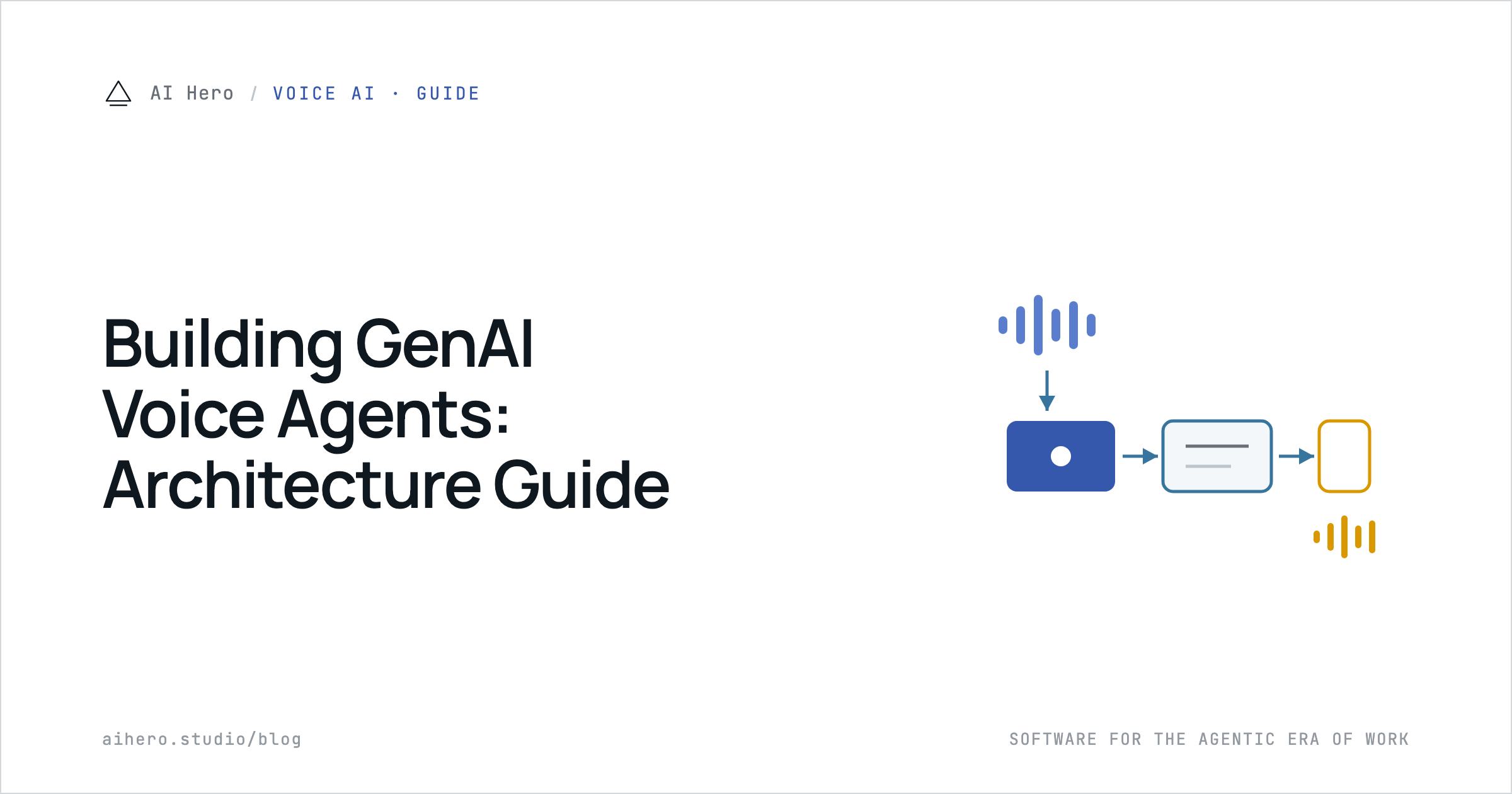
Building GenAI Voice Agents: Architecture Guide
By AI Hero Team
A working guide for teams putting voice agents into production: the two architectures and how to choose between them, where to run the agentic loop, the vendor ecosystem, conversation design, safety, day-2 operations, and a cost model you can defend to your CFO. The short version: the decision is a latency-versus-governance tradeoff, and most real deployments run both architectures and route per conversation.
AI Hero Achieves SOC 2 Type II Compliance
By AI Hero Team
AI Hero has completed its SOC 2 Type II audit: an unqualified opinion with no exceptions, covering security, availability, and confidentiality controls over a three-month window. What the audit covered, and how to request the report for your vendor assessment.